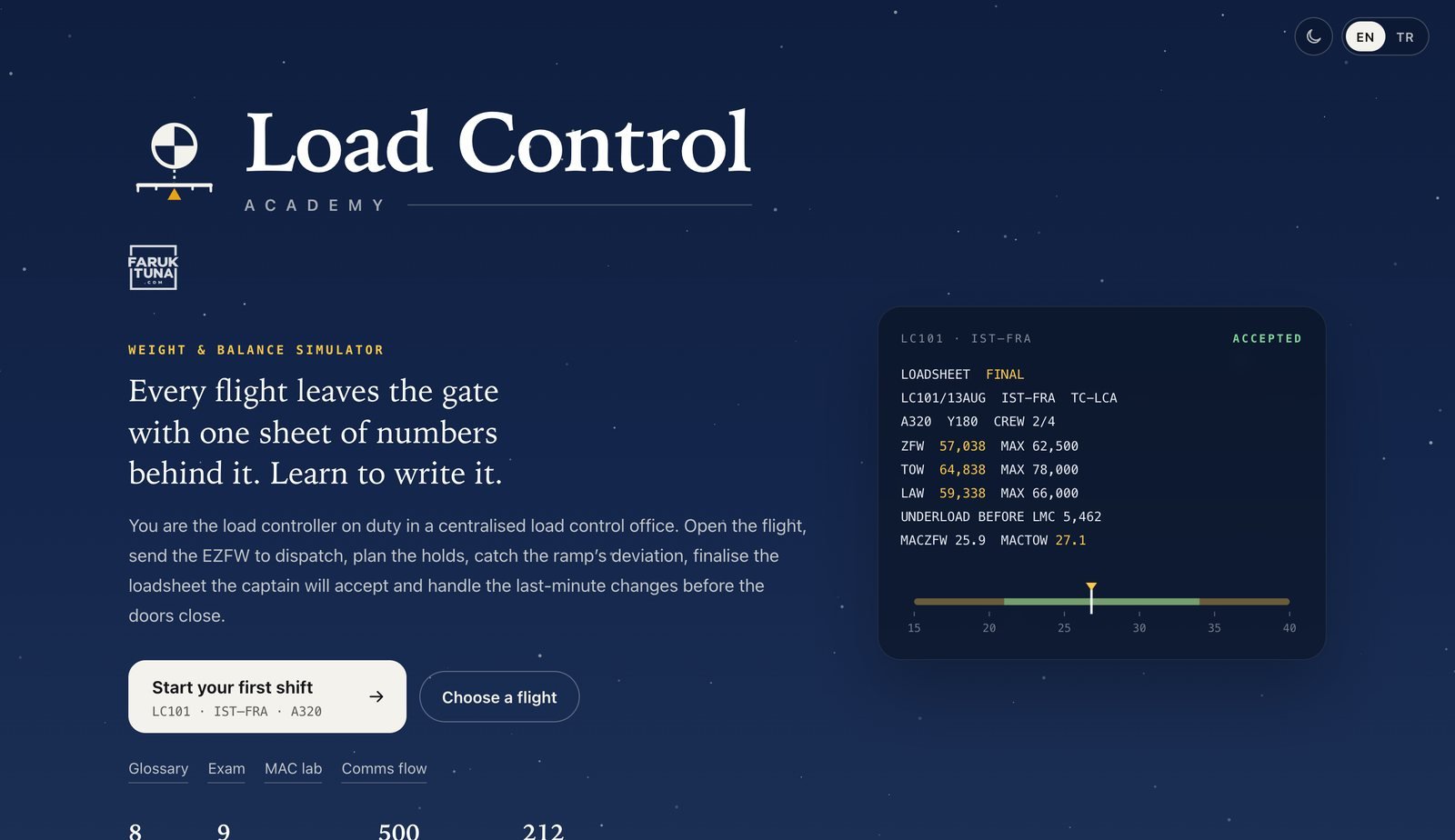
Load Control Academy: A Free Weight and Balance Simulator in Your Browser

Listen to this post · 9 min
Read by a synthetic voice.
Every flight you’ve ever taken left the gate with a single sheet of numbers behind it. How heavy the aircraft is without fuel, how heavy it is at take-off and landing, where its centre of gravity sits, and what the stabiliser trim should be. That document is the loadsheet, and the people who produce it work in load control, usually in an office far from the aircraft, watching dozens of flights at once.
I work in ground operations at Turkish Airlines, as a Ground Operations Risk Manager, and I’ve always felt load control is one of the least visible and most important jobs in aviation. So I built Load Control Academy: a browser game that puts you in a centralised load control office and walks you through the whole weight and balance process, from check-in to offblock.
Start a shiftEight flights, a free sandbox and a 500-question exam. Free, in your browser, no sign-up.
Open Load Control Academy →
What is load control, in one paragraph?
Before an aircraft can fly, someone has to prove that it is within its structural weight limits and that its centre of gravity (CG) is inside the certified envelope. Load control collects the inputs (passenger figures from check-in, cargo and mail manifests, fuel from dispatch, the ramp agent’s loading report), decides where the baggage and cargo go, and turns everything into the loadsheet the captain accepts before take-off. Get it wrong and the consequences range from extra fuel burn to a mis-set trim and a tailstrike.
A full shift, step by step
The core of the app is the Game. You are the load controller on duty in a CLC (Centralised Load Control) office, and you work through nine phases: Roles, Flight Init, EZFW, Load Plan, Ramp Report, Final Loadsheet, LMC, Offblock & Messages and Debrief. A live loadsheet on the right fills in as you go, so you can watch the document take shape.
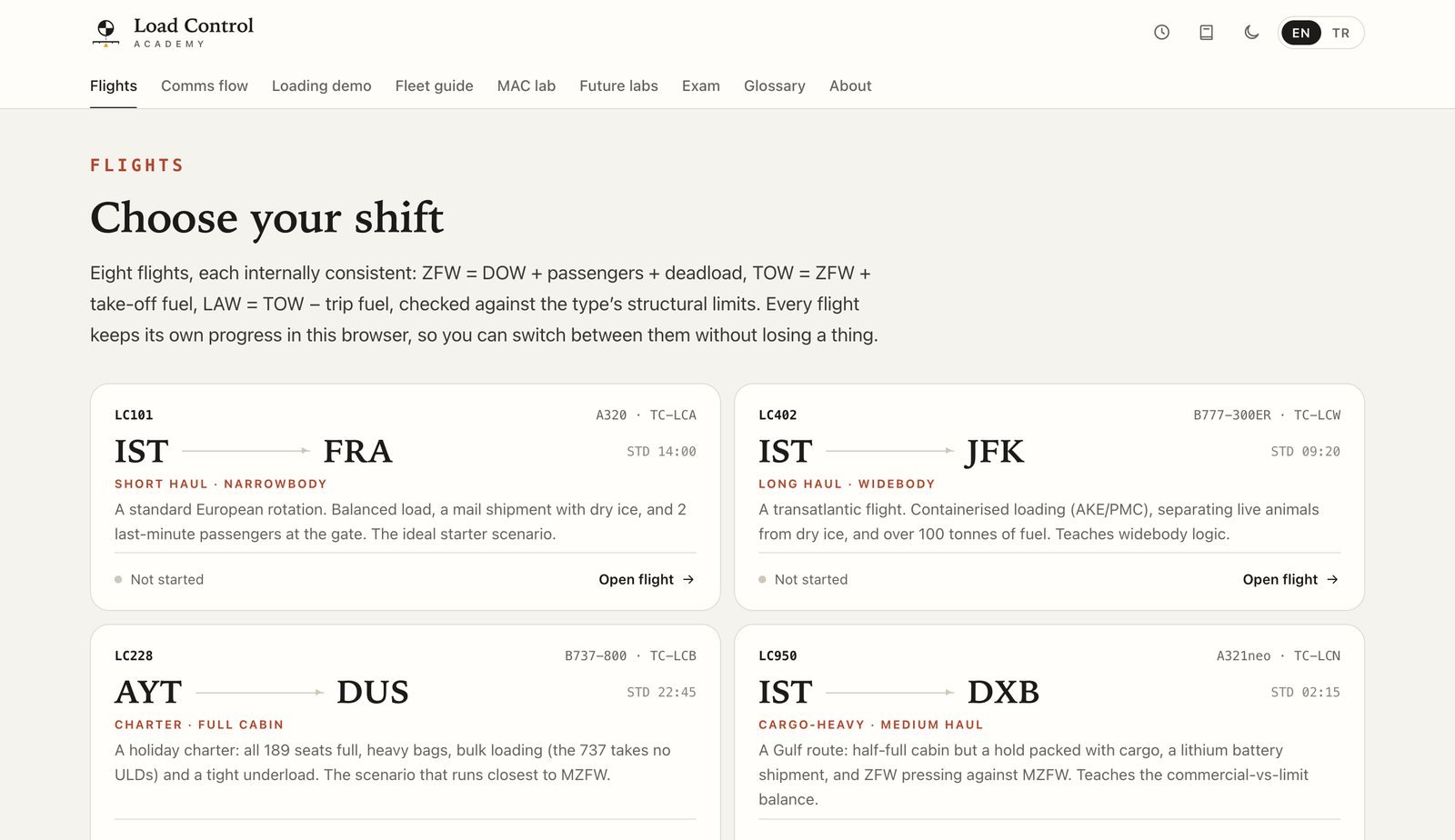
It opens by introducing the people involved: the load controller (that’s you), the shift supervisor, the load control manager, the ramp agent and the captain. Then the work starts at STD minus three hours:
- Initialise the flight. Where do the DOW and DOI come from? (From the fleet database for that registration and version, not from yesterday’s loadsheet.)
- The EZFW loop. Estimate the zero fuel weight from bookings and planned deadload and send it to dispatch, who return the fuel figures.
- Load plan (LIR). Distribute bags, cargo and mail across the holds.
- Check-in closes and the ramp reports a deviation. Do you enter it, ignore it, or ask for a restow?
- Final loadsheet and pilot acceptance.
- Last minute changes. Two more passengers just turned up at the gate.
- Offblock and the post-departure messages.
Each decision is a short multiple-choice question with an explanation, and the answers are scored. The wrong options aren’t silly: they’re the shortcuts people are genuinely tempted to take under time pressure, with a note on why they cause trouble.
Planning the holds
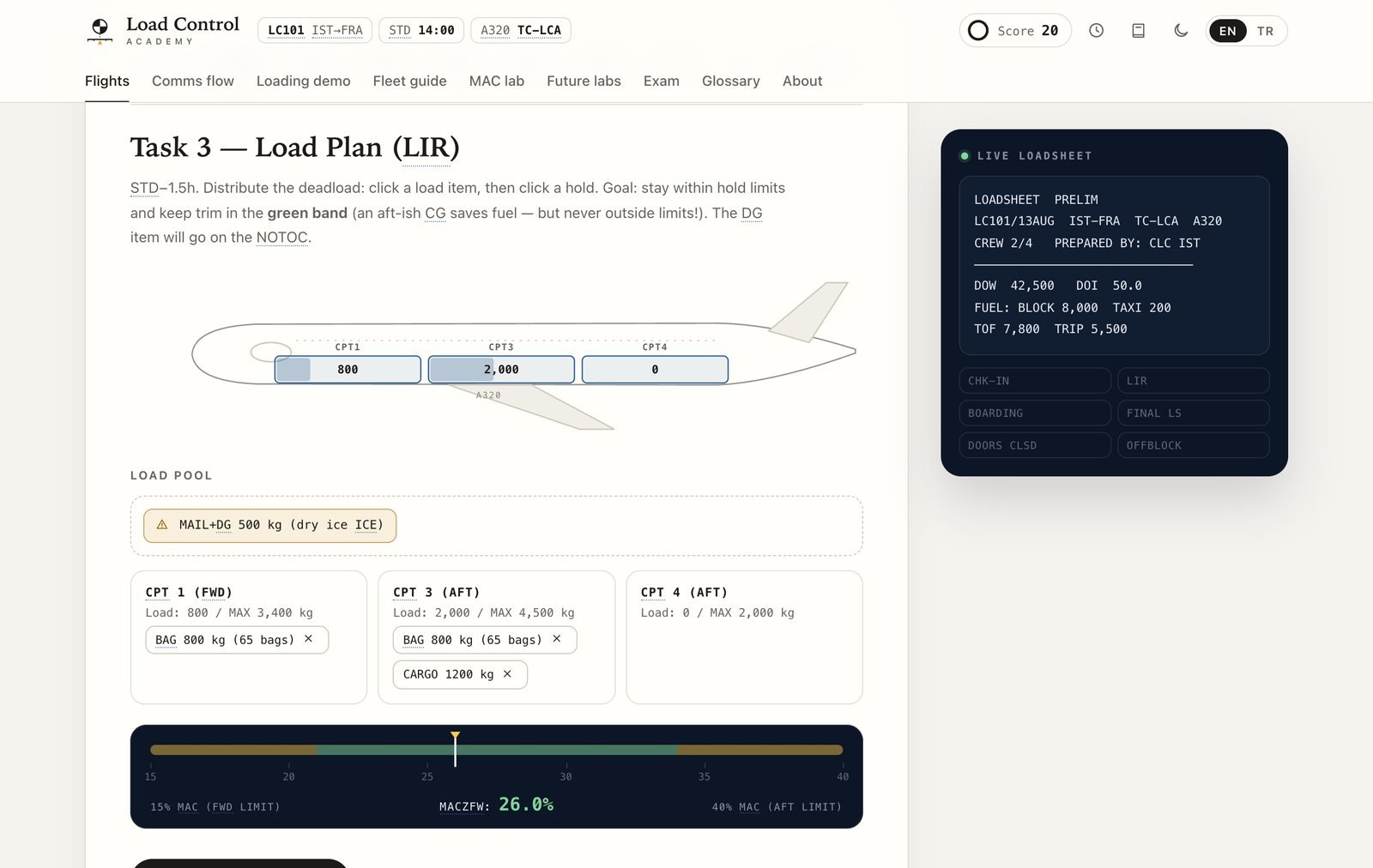
The load plan is the most hands-on part. You click a load item, then click a hold, and a trim gauge shows where your zero fuel CG lands between the forward and aft limits. Hold limits can’t be exceeded, the CG has to stay inside the envelope, and the green band rewards a well-balanced plan. Dangerous goods, like the dry ice in the mail on the first flight, are flagged so they end up on the NOTOC.
The final loadsheet
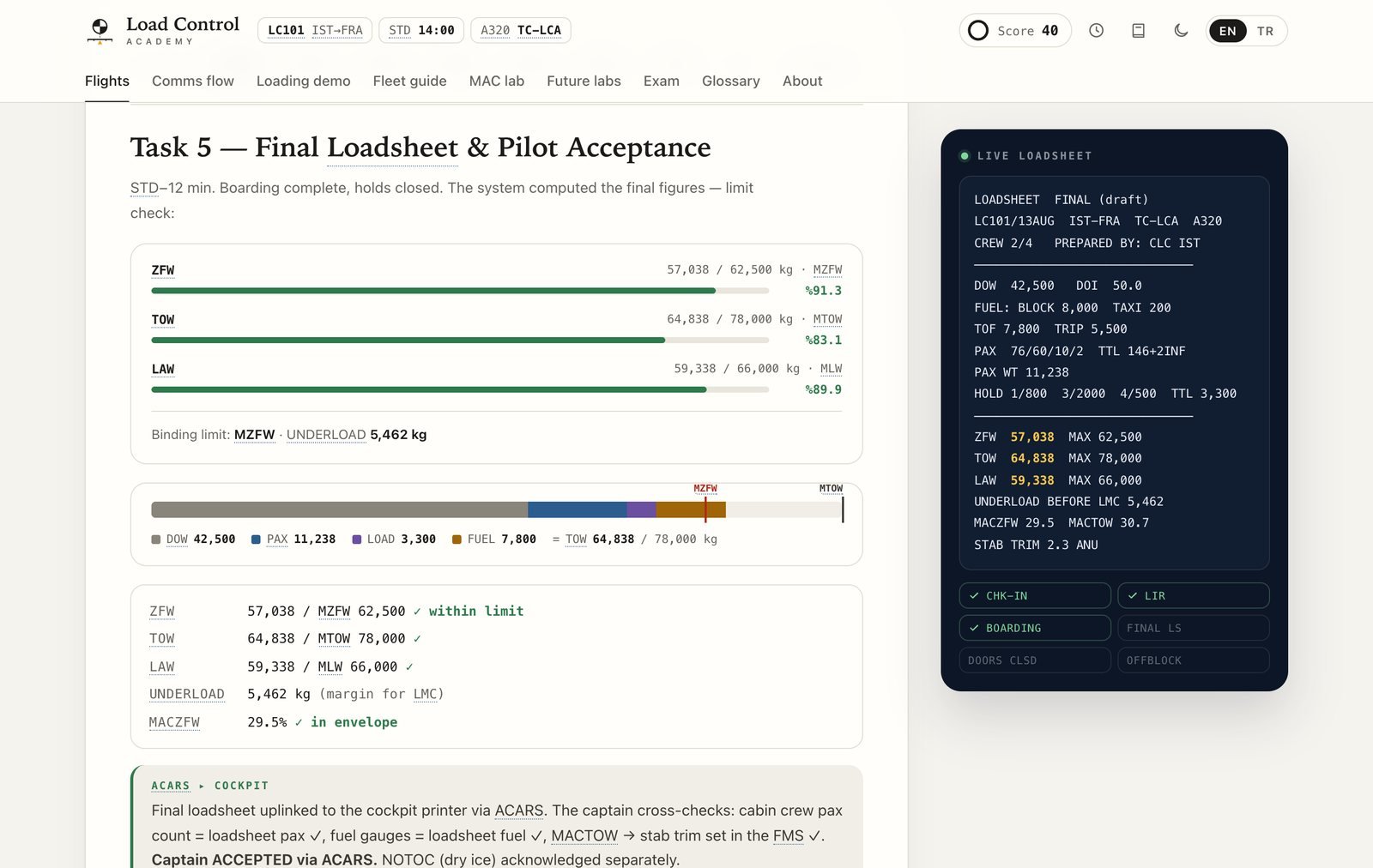
Once boarding is complete, the system computes the final figures and checks them against the limits: ZFW against MZFW, TOW against MTOW, LAW against MLW. It shows which limit is binding, how much underload is left for last minute changes, and the %MAC at zero fuel and take-off weight. The captain then cross-checks the loadsheet and accepts it via ACARS.
Eight flights, eight lessons
Every scenario is built to teach something different, and the numbers are checked against each type’s structural limits.
- 8flight scenarios
- 9phases per shift
- 34aircraft types in the fleet guide
- 500exam questions
- 212glossary terms
- LC101, Istanbul to Frankfurt (A320): the starter scenario, with mail and dry ice and two late passengers.
- LC402, Istanbul to New York (B777-300ER): containerised loading with AKE and PMC, live animals kept apart from dry ice, and over 100 tonnes of fuel.
- LC228, Antalya to Düsseldorf (B737-800): a full holiday charter, bulk-loaded, running closest to MZFW.
- LC950, Istanbul to Dubai (A321neo): a cargo-heavy hold with lithium batteries.
- LC780, Istanbul to São Paulo (A350-900): how 86 tonnes of fuel eat into the traffic load on an ultra long-haul sector.
- LC533, Ankara to Istanbul (A319): a light load with human remains on board, and why CG gets harder to manage when the aircraft is nearly empty.
- LC744, Istanbul to Jeddah (A330-300): a pilgrimage charter with 320 passengers, charter standard masses and wheelchair batteries.
- LC404, Istanbul to Izmir (A320neo): tankering on a short sector, where MLW becomes the binding limit.
The fuel figures alone show how different the eight days are. Here is the block fuel each scenario starts with:
Block fuel per scenario
| Flight | Block fuel (t) |
|---|---|
| LC533 ESB–IST | 6.3 |
| LC101 IST–FRA | 8.0 |
| LC404 IST–ADB | 8.5 |
| LC228 AYT–DUS | 9.2 |
| LC950 IST–DXB | 15.5 |
| LC744 IST–JED | 34.5 |
| LC780 IST–GRU | 86.0 |
| LC402 IST–JFK | 105.0 |
Beyond the game
The game teaches the process. The other tabs are for understanding what sits behind it.
Comms Flow
Load control is really a message flow. The Comms Flow view animates who tells whom what, in sixteen steps: passenger data from the DCS, the manifest from cargo, EZFW to dispatch, the LIR to the ramp, fuel confirmation from the cockpit, the final loadsheet, the LMC, and the MVT and LDM/CPM messages after departure. Each step shows the actual message on the wire.

MAC Lab and Loading Demo
%MAC is probably the most memorised and least understood idea in load control. The MAC Lab explains it from scratch: what the mean aerodynamic chord is, why CG is expressed as a percentage rather than in metres, how moments add up to %MAC, why the envelope narrows as weight increases, and how MACTOW becomes the stabiliser trim setting.
The Loading Demo is a free sandbox. Choose an A321-200, B737-800, B777-300ER or A330-300, drop bulk bags, containers, pallets, dry ice or live animals into the compartments, and watch the CG, compartment limits and ULD compatibility warnings react.


Fleet Guide, Future Labs, Timeline and Glossary
The Fleet Guide compares 34 Airbus and Boeing types, narrowbody and widebody, with their key weights, capacities and whether they take ULDs or are bulk-loaded. Future Labs looks ahead at where load control is going: a stats hub, a trend radar, an innovation library and a 2040 horizon. The Timeline lays out a typical narrowbody turnaround relative to STD, and the Glossary holds 212 terms, searchable in both English and Turkish. Hover over any dotted-underlined abbreviation in the app and you get its expansion.
Test yourself: the 500-question exam
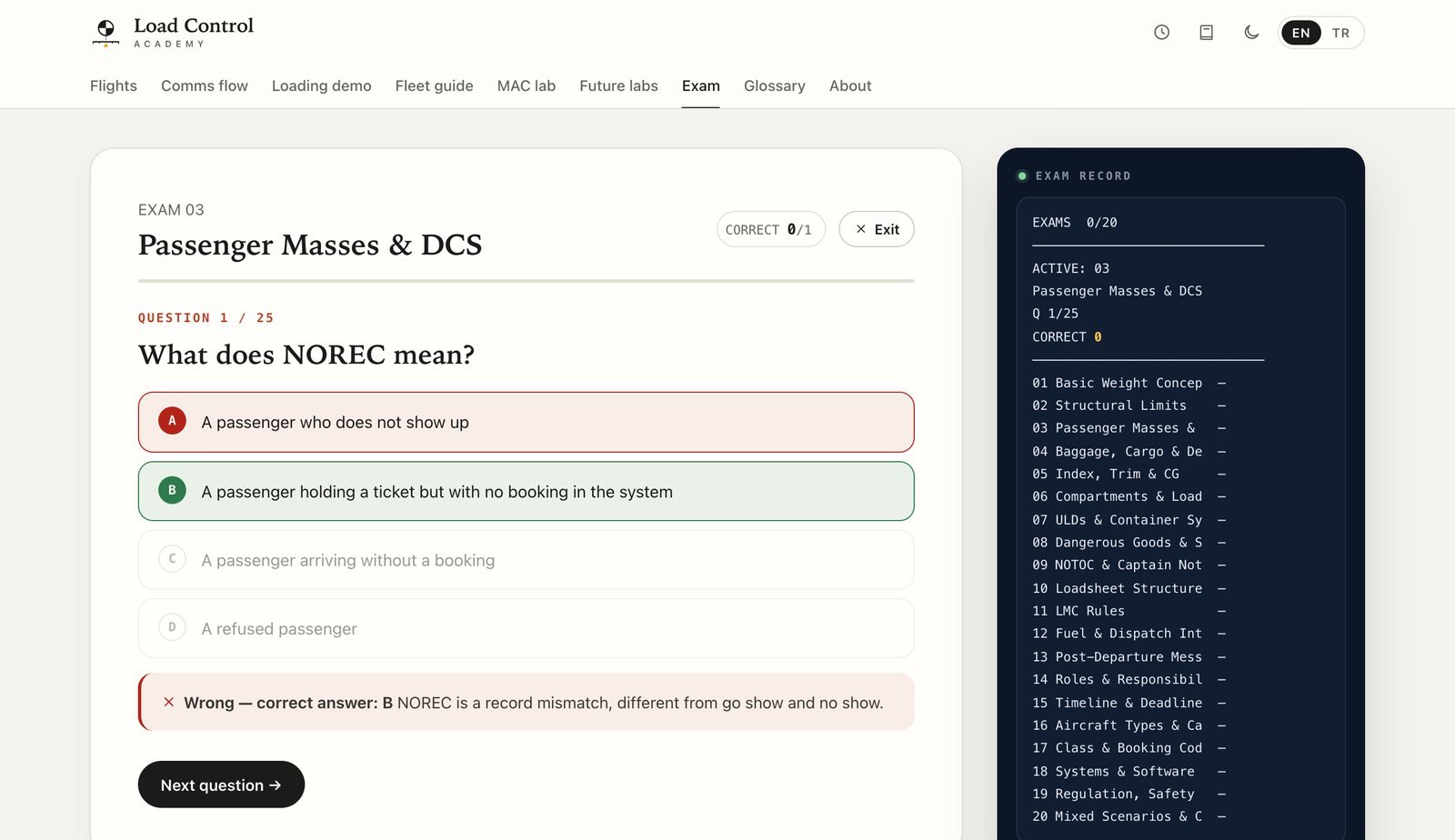
When you think you’ve got it, open the Exam. There are 500 questions split into 20 exams of 25, from basic weight concepts and structural limits to dangerous goods, NOTOC, LMC rules, post-departure messages and mixed scenarios. Questions and options are reshuffled on every attempt, and after each answer you see the correct option with the reasoning. Your scores are stored only in your browser, and you can retake any exam.
Who it’s for
I built Load Control Academy for people starting out in load control and ground operations, for aviation students, and for anyone who has ever wondered what happens between check-in closing and the aircraft pushing back. It works in English and Turkish, in light and dark mode, and needs nothing but a browser.
One honest note: it’s an educational prototype. The figures are illustrative, and real operations always follow the airline’s approved manuals. But the logic, the order of things and the reasons behind them are the same ones load controllers deal with every day.
If you enjoy aviation games, you might also like my Airport Quiz.
Your shift starts nowOpen LC101 to Frankfurt and see if you can get the loadsheet to the captain on time.
Play Load Control Academy →More things I’ve built live on the projects page.
Builder and lifelong starter. At Turkish Airlines since 2013, founder of inovanadolu, PhD in innovation. I write about aviation, entrepreneurship, innovation and the new world order.
About me →