The Psychology Behind Innovation Failure

Listen to this post · 6 min
Read by a synthetic voice.
Everyone loves to talk about fear of failure. There are keynotes about it, mugs about it, and at least one consultant who will charge you a week’s salary to say “fail fast” while clicking through a slide with a rocket on it.
Fear of failure is real. But after years of running corporate innovation programmes, and an idea platform with tens of thousands of people on it, I’ve come to believe it’s the smaller problem. The bigger one is quieter, more embarrassing, and almost nobody puts it on a slide:
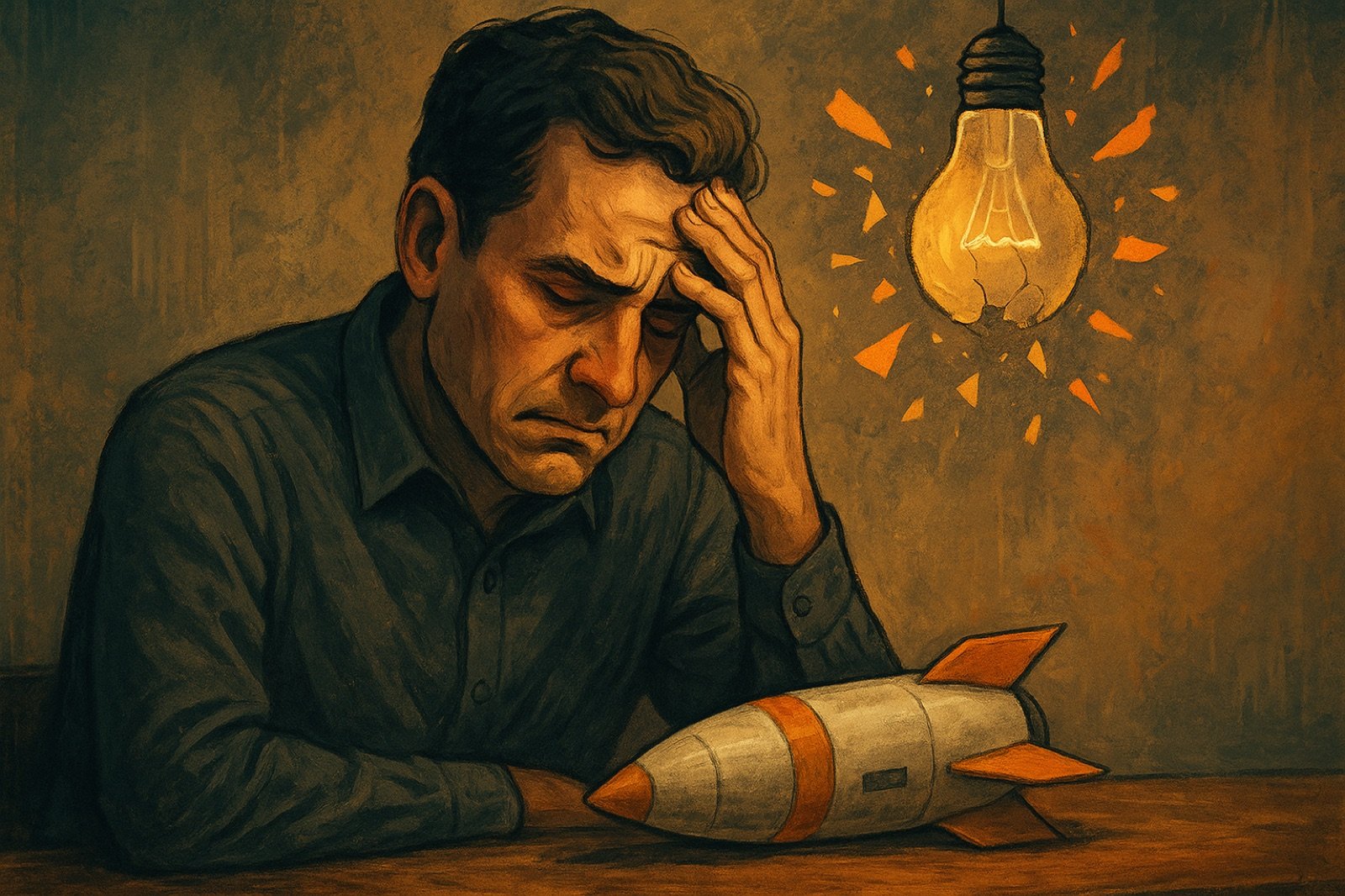
We’re scared our ideas might actually work.
Because if it works, then what? Then you have to own it. Defend it. Explain it to people more senior than you. Do it again. And possibly be wrong, in public, at a much larger scale.
So we find very creative ways to make sure it doesn’t come to that.
Pilot purgatory
The most popular way to kill an idea is to never let it finish.
You’ve seen it. The project gets approved, which feels like winning. It becomes a “pilot”. The pilot goes well, so naturally it gets a second pilot, “with a slightly wider scope”. Then a third, “to validate the learnings”. Eighteen months later the team has an excellent deck, a hundred happy users and absolutely no plan to scale anything.
Nobody said no. That’s the genius of it. Saying no is risky; it leaves fingerprints. A pilot that never ends is the corporate equivalent of leaving someone on read.
Innovation theatre
Then there’s the performance. Hackathons with free pizza and a winner chosen by whoever stayed latest. Beanbags. A wall of sticky notes photographed beautifully for the internal newsletter and quietly binned on Monday. An “innovation day” scheduled once a year, so the other 364 days can stay exactly as they are.
Theatre isn’t useless. It’s fun, it gets people talking, and occasionally a real idea sneaks out. The problem is when the show becomes the point, because a show can’t fail. A show only needs an audience and good lighting.
The Jonah complex, now with Slack notifications
Abraham Maslow had a lovely name for this decades ago: the Jonah complex, our habit of running away from our own potential, like Jonah running from the job he was given. We fear our worst, sure. But we’re oddly nervous about our best too.
At work it sounds like this:
- “Let’s not over-promise.” (Translation: let’s not promise.)
- “It’s still a bit early to share.” (It has been early for two years.)
- “Maybe after the reorg.” (There is always a reorg.)
The psychologist Gay Hendricks calls a version of it the upper limit problem: things start going well, you hit your internal ceiling for “how good things are allowed to be”, and you find a way to sabotage it. Picking a fight. Missing the deadline. Suddenly deciding the logo needs work.
Tall poppies and helpful crabs
Some of the fear isn’t even ours. It’s borrowed.
In plenty of cultures, and almost every large organisation, there’s a quiet rule: don’t stick your head up too far. Australians call it tall poppy syndrome. Elsewhere it’s the crab mentality, the crabs in the bucket that pull back any crab trying to climb out. Not out of malice, mostly. More out of a sort of anxious solidarity. “Who does he think he is?” is rarely said out loud. It doesn’t need to be.
So the person with the good idea does the maths. Succeed, and you become a target. Stay average, and you get to keep your friends at lunch. It’s not a hard calculation.
Impostor syndrome, but make it a strategy
Impostor feelings are normal. The fun part is how we weaponise them against ourselves.
If I never quite finish the thing, nobody can judge the finished thing. If I keep calling it a prototype, its flaws are features. If I keep polishing, I never have to ship. Perfectionism is often just fear wearing a nicer shirt.
My favourite version is the person who keeps saying “I’m not really an innovation person” while having more ideas in one coffee break than the innovation department has in a quarter.
The cringe tax
And then there’s a very modern one: the fear of being seen trying.
We live in a time where earnestness is risky. Post your side project and someone might screenshot it. Pitch a bold idea in a meeting and the room might go silent in that particular way. Trying hard has become slightly embarrassing, so a lot of people prefer to look effortlessly unbothered. Ironic distance is comfortable. It’s also where good ideas go to die.
The best founders I’ve met have an unusually high tolerance for looking a bit silly. That’s not a personality flaw. It’s the job description.
So what actually helps?
Not another poster. A few things that work, at least in my experience:
- Give pilots an ending. Decide up front what “success” means and what happens if you reach it. Scale, stop or change. “Continue piloting” is not an option on the form.
- Make it safe to succeed, not just to fail. Psychological safety, as Amy Edmondson describes it, is usually discussed as permission to make mistakes. It also has to mean permission to win without being punished for it by colleagues, budgets or the org chart.
- Reward the people who stop things. Killing a weak project early is a skill. Celebrate it, or people will keep feeding zombies.
- Lower the stage. Smaller, earlier, more frequent demos. The less dramatic the reveal, the less frightening the result.
- Notice your own ceiling. When things start going well and you suddenly feel like reorganising your desk, that’s probably not about the desk.
Innovation rarely fails because the idea was bad. Bad ideas are cheap and easy to spot. It fails because a perfectly decent idea met a perfectly normal human who was, quite reasonably, a little bit afraid of what would happen if it worked.
Which is funny, when you think about it. We spend so much energy preparing for failure. Hardly anyone prepares for success.
If you’re curious which parts of this sound uncomfortably familiar, the Innovator Profile might tell you a bit more about how you innovate, and what tends to stop you.
Builder and lifelong starter. At Turkish Airlines since 2013, founder of inovanadolu, PhD in innovation. I write about aviation, entrepreneurship, innovation and the new world order.
About me →